 Creating a super sterile environment in a farmhouse
Mr. James Ball (consultant ophthalmic surgeon) graduated with his medical degree from the University of Cambridge, United Kingdom, in 1995. After completing his ophthalmology training in Brighton, Oxford and Yorkshire, he moved to Australia for specialized training in laser eye surgery at the renowned Lions Eye Institute. There he contributed to the development of new techniques in refractive surgery. In 2014, Mr. Ball was appointed Honorary Consultant at Geneva University Hospital to support the development of their refractive, cataract and cornea service. After fifteen years of providing corneal and refractive surgery services within the NHS, he has now established his own practice at Custom Vision Clinic.
Mr. Ball decided to start his own clinic partly out of frustration with the environments in which he had previously been working. He founded Custom Vision Clinic at Bowcliffe Hall in Wetherby, United Kingdom, a nineteenth-century estate. The SurgiCube made it possible to create a new ultra-sterile operating room during the Covid-19 pandemic. The new facilities demonstrate that high-quality surgical environments can be developed even within historic buildings when supported by the right technology.
“My idea for establishing Custom Vision Clinic came from knowing that things could be done a little better,” explains Mr. Ball. “I found the right location and started with just a few rooms and diagnostic equipment. That allowed us to build the first phase of the clinic about five years ago. Then, during the pandemic in 2020, we built an operating theater along with a laser treatment suite.”
Mr. Ball first learned about the SurgiCube in 2013. He visited Dr. Gerrit Melles, pioneering corneal specialist and inventor of the SurgiCube, in Rotterdam to observe demonstrations of the latest corneal transplant techniques. During these demonstrations, patients were operated under a SurgiCube. Interested in the technology, he has followed its development closely ever since.
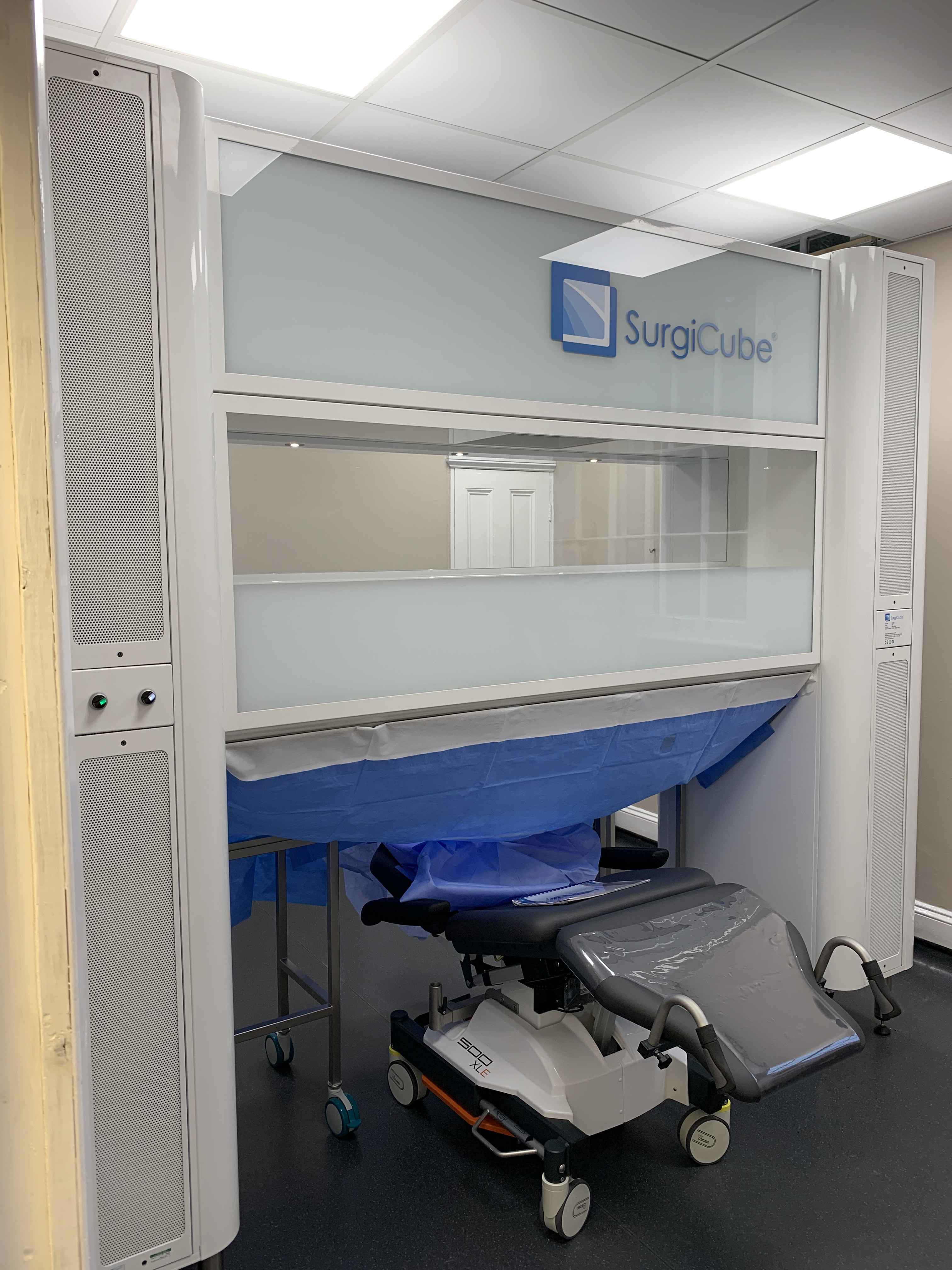
“There were two key reasons for me to use the SurgiCube. The first was that it allowed me to create an ultra-sterile environment inside a historic listed building, which naturally comes with certain restrictions. Achieving sterility using conventional air treatment systems in such a setting is very difficult. The limitations are partly due to the age of the building, partly its size, and partly its location, right next to fields and trees. It is, of course, a beautiful place. Providing a calming environment is beneficial for patient recovery. However, it also means there are many insects around, and their presence poses a real challenge for maintaining sterility.”
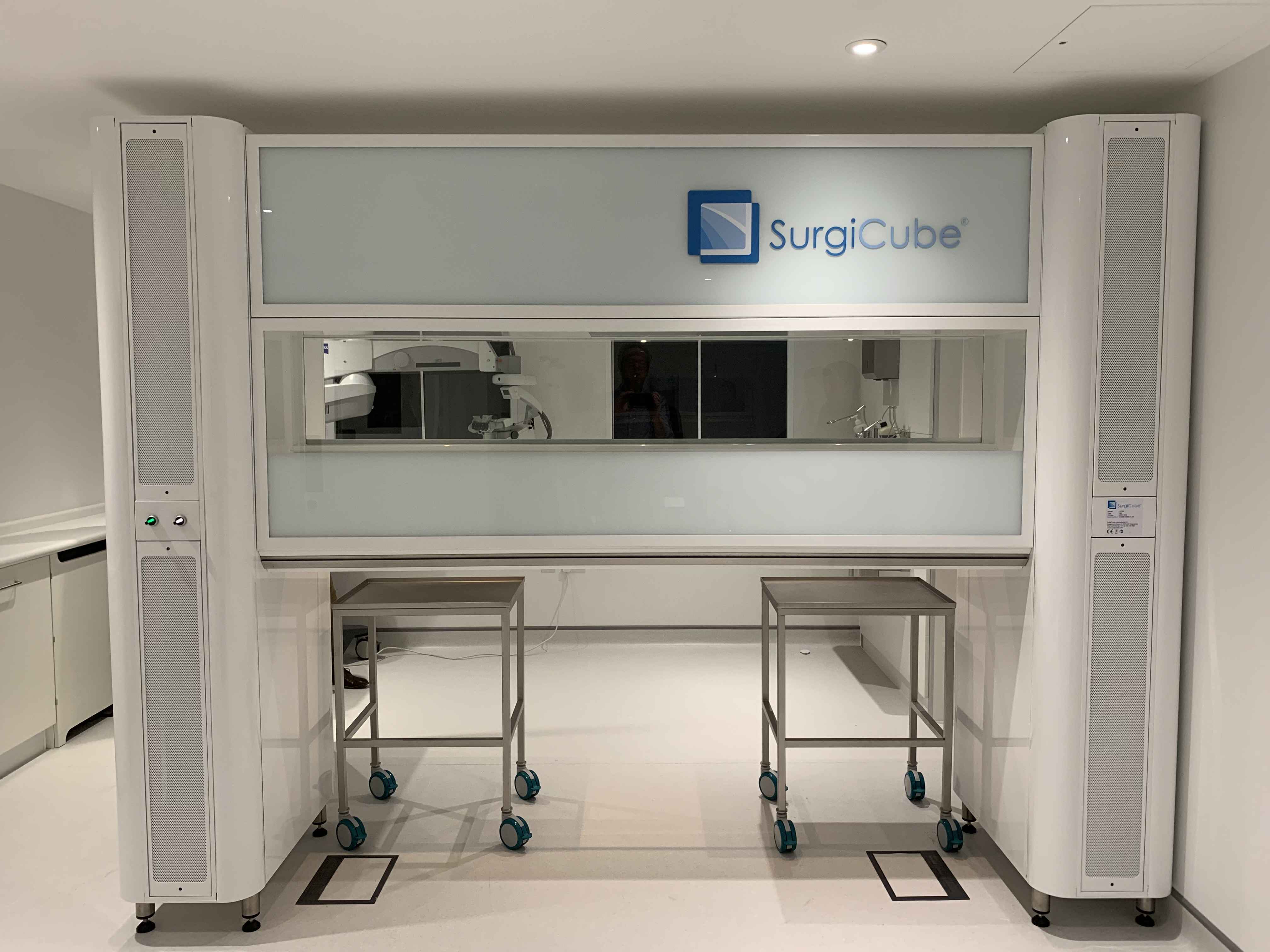
“The second major driver was Covid-19. I spent a great deal of time studying air management to make the physical environment as safe as possible, particularly the air that my staff, my patients and I are breathing. The SurgiCube simply outperforms the alternatives because the system separates us from the patient and filters any virus particles within minutes. In the early months of the pandemic, there was concern because cataract surgery can be considered an aerosol-generating procedure due to the vibrating instruments used.
In most operating theaters, everyone must leave the room for around half an hour after each procedure so that the conventional ventilation system can remove any airborne virus. The SurgiCube filters a very large volume of air in a small space and removes everything. This minimizes the turnaround time between patients. The SurgiCube provides additional confidence that I can care for people in a safe environment. I genuinely believe that the SurgiCube is the best system available for protecting both staff and patients in the operating room.”
The SurgiCube was installed at the end of August 2020, in time for the first Custom Vision Clinic surgical list on 10 September 2020. Since then, Mr. Ball and his team have performed hundreds of successful procedures with the system. “It is a pleasure to work with,” he notes. “For me, it has introduced a new standard of sterility. Even compared to a first-class operating theater in a hospital, I still prefer to operate under my SurgiCube. The SurgiCube creates an environment where I know I am working in ultra-sterile air.
When I look around a hospital operating room, people are constantly entering and leaving, which means air is moving in and out from the corridor. I have more confidence in the SurgiCube than in a conventional operating environment. Once you have worked with it, you recognize the level of safety it provides for patients. I think you only truly understand this once you have been inside a SurgiCube. The gentle airflow you feel is intensely sterilized. The quality of air that we assume we are getting in a standard operating room can, in reality, be significantly improved. That was a remarkable shift in my perception once I began working with the SurgiCube.”
Since the SurgiCube was installed at The Custom Vision Clinic, several specialists have reached out with the intention of acquiring one for their own facilities. “The most recent visit came from specialists working in an operating theater elsewhere in the United Kingdom, where they had experienced two cases of endophthalmitis. This is the most feared complication for ophthalmologists,” Mr. Ball explains. “It is the one complication that will keep me awake at night. If this infection occurs, one third of patients will completely lose their vision, and in some cases may even lose the eye itself. It is the worst possible outcome. In my 15-year career as a consultant, with more than 10,000 procedures, I have never had to perform such a surgery and I intend to keep it that way. With the SurgiCube, I know with complete certainty that I am operating in the most sterile environment possible.”
The cost savings provided by the SurgiCube at Custom Vision Clinic are significant. “If I had chosen a conventional air handling system, it would have been twice as expensive,” says Mr. Ball. “Even if the cost had been the same, I would still prefer the SurgiCube because of the clinical advantages it offers. You can operate efficiently. We schedule nine patients per surgical list, which allows the workflow to remain calm and controlled. This was especially valuable during the Covid-19 period. At the moment of the procedure, we can begin, and 20–25 minutes later the patient can walk out comfortably.”
Mr. Ball believes the SurgiCube can continue to play an important role in expanding surgical capacity for cataract procedures, even beyond the Covid-19 period. Long waiting lists can be reduced using this system. “Another reason I continued building my own operating room in 2020 was that I realized one of the biggest challenges was a lack of available surgical facilities,” he explains. “The SurgiCube can transform a building that you would never have considered suitable for intraocular surgery. Another advantage of the SurgiCube is that it is mobile. This means I can confidently perform treatment in a new environment, knowing that the air is ultra-sterile and safe.”

The SurgiCube team is also fantastic. So not only is it a very good product, but the support has also been excellent. I think their service is an important part of the product. Of course, the SurgiCube is not only suitable for eye surgery.
dhr. Ball
Custom Vision Clinic
There are many minor surgical procedures that healthcare providers are trying to deliver in facilities that have come under significant pressure as a result of the pandemic. Many surgical specialties can benefit from access to additional operating environments. This is what the SurgiCube can offer alongside existing operating theaters. The system provides a way to quickly increase surgical capacity. And this applies far beyond the United Kingdom.
Interested in a deeper exploration of our methods? Sign up to download more information.



